

A loader pours gravel into a dump trailer. Photo: Acadian Services.
A full-size pickup looks like it was built for a load of gravel. The bed is wide, the tailgate drops, and the suspension sits high. The trouble is that the bed’s volume and the truck’s payload rating are two different numbers, and for dense materials they do not line up.
Homeowners who haul their own dirt, sand, or gravel tend to think in cubic yards because suppliers sell it that way. Trucks, though, are rated in pounds. The gap between those two units is where an ordinary weekend errand can turn into an overloaded vehicle.
How Much Gravel Actually Weighs
Start with the material. Engineering ToolBox, an online technical reference, lists dry gravel at 105 pounds per cubic foot and wet gravel at 125. A cubic yard holds 27 cubic feet, so a yard of dry gravel weighs about 2,835 pounds (105 times 27). Wet gravel comes to about 3,375 pounds (125 times 27).
Sand and soil are lighter but not light. The same reference lists dry sand at 97 pounds per cubic foot, wet sand at 119, loam at 80, and loose dry dirt at 76. Multiply by 27 to get roughly 2,620 pounds per yard for dry sand, 3,210 for wet sand, 2,160 for loam, and 2,050 for loose dry dirt.
Moisture matters. By those figures, a yard of wet sand weighs about 590 pounds more than a yard of dry sand (3,213 minus 2,619).
For anyone checking the numbers before ordering, a recent guide that charts how much a cubic yard of dirt, sand, and gravel weighs lays these figures side by side.
What a Truck Bed Holds by Volume
Now the container. Michigan State University Extension, answering a homeowner’s topsoil question through the Ask Extension service, put it simply: “A full size pickup truck holds about 2.5 cubic yards.”
That is a statement about space, not weight. Filled to that volume with dry gravel, the bed would hold roughly 7,090 pounds of stone (2.5 times 2,835). With loose dry dirt, the figure is still about 5,130 pounds (2.5 times 2,052). The next question is how those numbers compare with what the truck is allowed to carry.
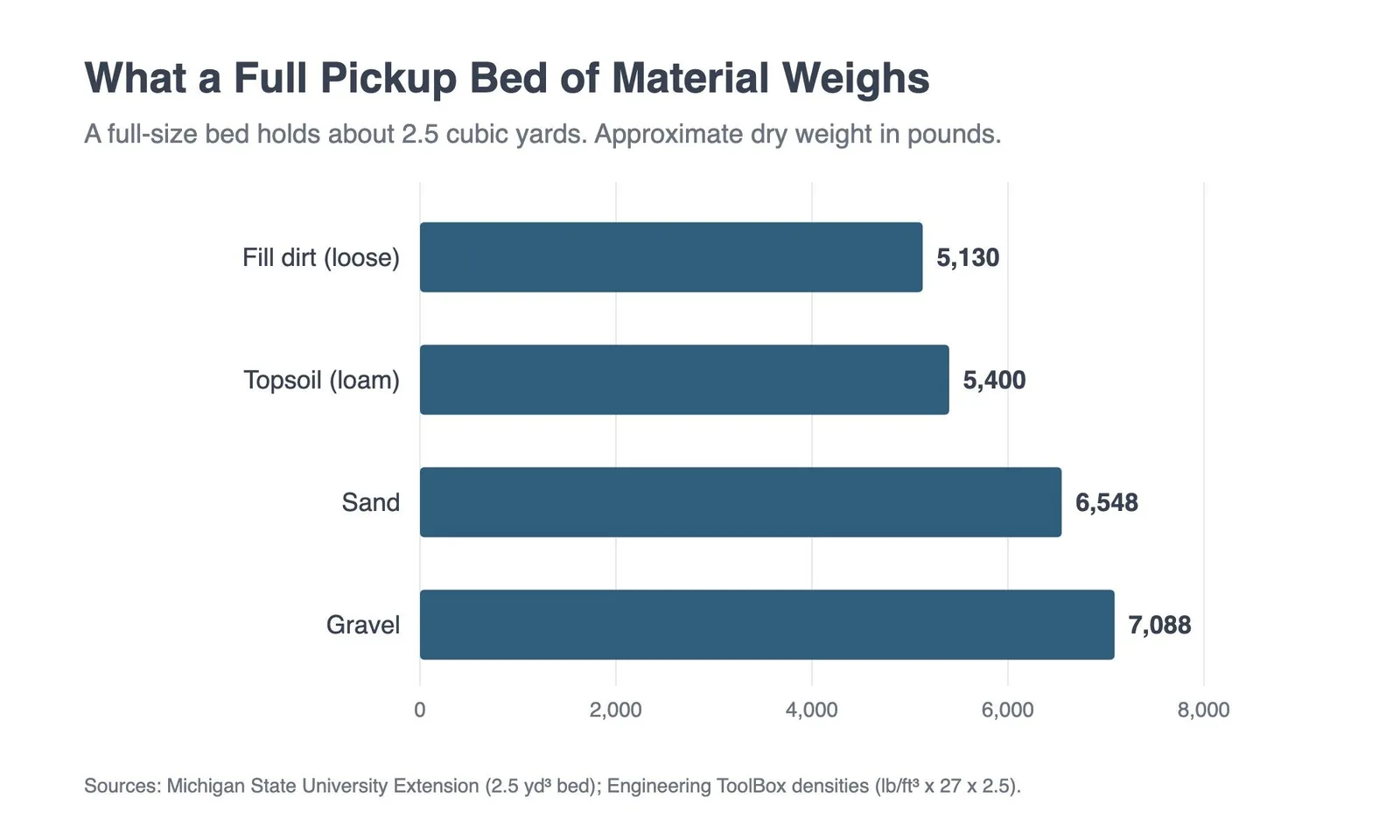
Approximate dry weight of a full 2.5-cubic-yard pickup bed. Sources: MSU Extension, Engineering ToolBox.
What Half-Ton Pickups Are Rated to Carry
Manufacturers publish a maximum payload for each model, and the headline numbers for three common half-ton trucks are close together. Ford lists a best-in-class maximum available payload of 2,440 pounds for the 2026 F-150. Ram lists a maximum available payload of 2,360 pounds for the 2026 Ram 1500.
Chevrolet lists a maximum payload of 2,340 pounds for the 2027 Silverado 1500 with the 2.7-liter TurboMax engine. Its footnote ties that figure to a Regular Cab, Standard Bed, two-wheel-drive configuration. The same page lists 1,510 pounds of maximum available payload for the 6.6-liter V8, which its footnote ties to a Crew Cab ZR2 four-wheel-drive truck.
That spread is the point. An advertised maximum belongs to one specific build, not to every truck wearing the badge. Ford’s fine print says, “Max payload varies based on accessories and vehicle configuration,” and tells owners to check the door jamb label for a specific vehicle’s carrying capacity. Chevrolet’s footnotes give the same instruction.
Compare those ratings with the material math. A single cubic yard of dry gravel, at about 2,835 pounds, is heavier than any of the three maximum payload figures above. One yard of dry sand, at about 2,620 pounds, is also over all three. A bed filled to its 2.5-yard volume with gravel would be close to three times the highest of them (7,090 divided by 2,440 is about 2.9).
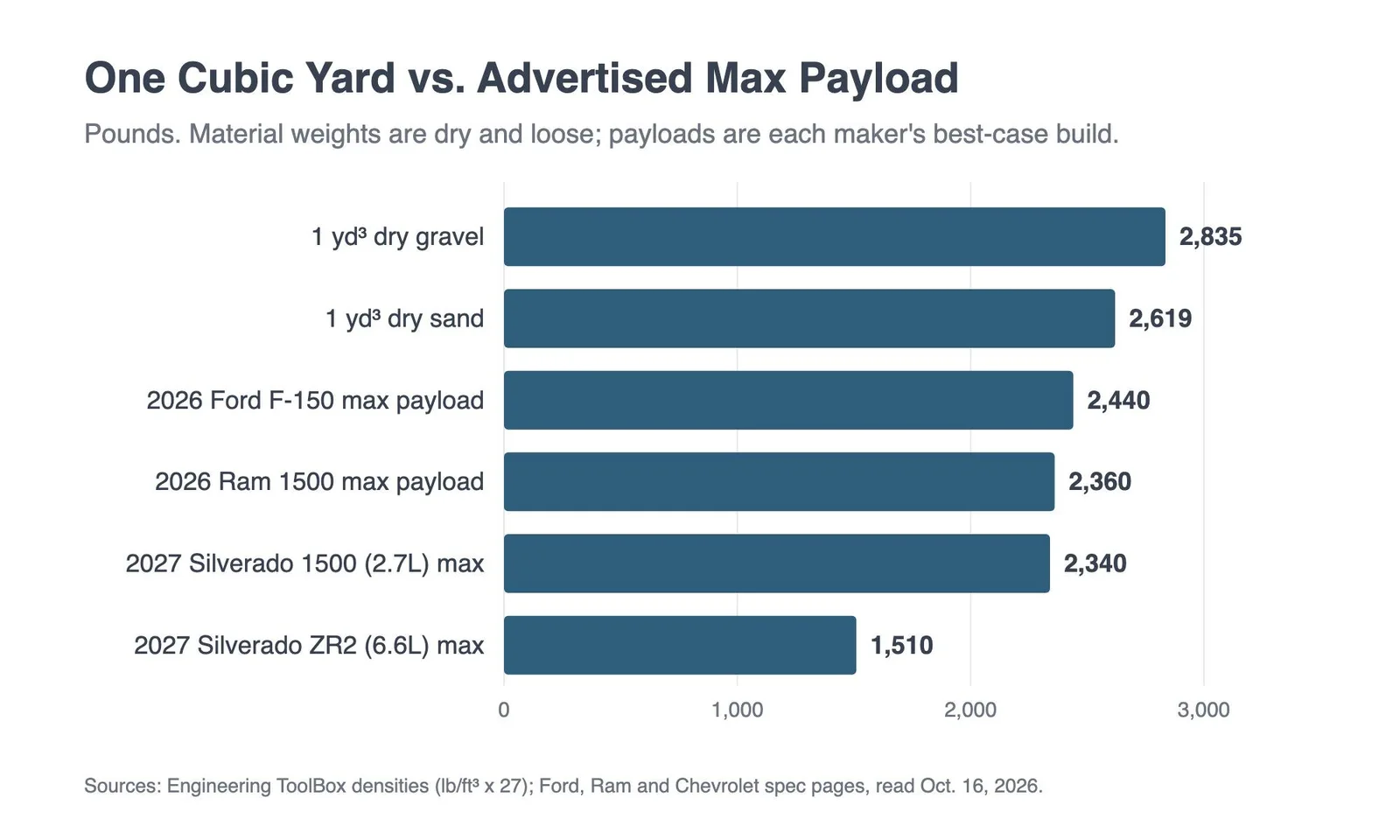
One cubic yard against advertised maximum payloads. Sources: Engineering ToolBox; Ford, Ram and Chevrolet spec pages.
Where to Find Your Own Truck’s Limit
The number that governs a particular truck is printed on the truck. The National Highway Traffic Safety Administration tells drivers to find the Tire and Loading Information label “on the driver’s side door edge or post or in the owner’s manual.” In its consumer brochure, Tire Safety: Everything Rides On It, NHTSA explains what those labels mean.
According to the brochure, the labels include vehicle capacity weight, defined as “the maximum occupant and cargo weight a vehicle is designed to carry,” plus front and rear gross axle weight ratings, “the maximum weight the axle systems are designed to carry.”
The brochure says these placards and certification labels are “permanently attached to the vehicle door edge, door post, glove-box door, or inside of the trunk lid.”
Federal rules spell out how owners should use the placard. Under the federal consumer information rule at 49 CFR 575.6, owners’ manuals must tell drivers to find the statement “The combined weight of occupants and cargo should never exceed XXX” pounds, then subtract the driver’s and passengers’ weight.
The regulation’s own example uses a 1,400-pound limit and five passengers at 150 pounds each, leaving 650 pounds for cargo (1,400 minus 750). The occupants come out of the same budget as the gravel.
Running the Numbers on a Real Load
Apply that method to the published maximums, using the regulation’s 150-pound figure for a lone driver. An F-150 configured for its 2,440-pound maximum would have about 2,290 pounds left for cargo. That covers about 0.8 cubic yards of dry gravel (2,290 divided by 2,835), or a little over one yard of loose dry dirt (2,290 divided by 2,052).
Run the same steps on the Silverado ZR2 rating of 1,510 pounds. After a 150-pound driver, about 1,360 pounds remain. That is roughly half a yard of dry gravel (1,360 divided by 2,835) or about two-thirds of a yard of loose dry dirt (1,360 divided by 2,052).
Those are best-case figures built on advertised maximums. A toolbox, a bed liner, a second passenger, or a hitch accessory all draw from the same allowance. The only reliable starting point is the placard on the truck in the driveway, and the owner’s manual that explains it.
What Overloading Does to Tires, Brakes, and Handling
The federal rule treats overloading as a safety topic, not a technicality. It requires owner’s manuals to explain the “adverse safety consequences of overloading on handling and stopping and on tires.”
NHTSA’s brochure is direct about the tire side: “Underinflated tires and overloaded vehicles are a major cause of tire failure.” It adds that “excessive speed, underinflation or excessive loading, either separately or in combination, can cause heat build-up and possible tire failure.”
The same brochure notes that properly maintained tires improve “the steering, stopping, traction, and load-carrying capability” of a vehicle. Its checklist is blunt: “Do not overload your vehicle.” Because the label also lists separate front and rear axle ratings, a load can be a problem for one axle even when the overall total looks acceptable.
Why Small Loads Often Ride in a Dump Trailer
A trailer changes the math because it brings its own rating. The federal rule requires trailers to carry a placard statement that “the weight of cargo should never exceed XXX” pounds, so the cargo limit belongs to the trailer itself rather than to the pickup bed.
That does not make the tow vehicle irrelevant. The regulation tells drivers that “load from your trailer will be transferred to your vehicle,” and NHTSA’s brochure says “some of the weight of the loaded trailer is transferred to the towing vehicle.” The truck’s ratings still apply to that share, and the owner’s manual sets the towing limits.
Still, spreading a multi-ton load across a trailer’s axles is a different proposition from stacking it in a bed rated for roughly a ton. That helps explain why a few yards of gravel or fill is better suited to equipment rated for the weight than a pickup bed.
A Measured Look at the Consumer Math
None of this means a pickup cannot carry bulk material. It means the safe quantity is often far smaller than the bed suggests, sometimes less than a single yard. Buyers who price a self-haul against delivery may find that the comparison involves more trips, or more weight, than they first assumed.
Even with half-ton maximums now listed above 2,000 pounds, the gap between how much a bed holds and how much a truck is rated to carry remains. For dense materials, the door-jamb placard, not the size of the bed, remains the number that decides the load.
Disclosure: The author also wrote the Idea Crossing guide cited above.

The macro analyst desk brings highly sought after financial news based on market analysis, insider news and company filings.