

Most households only think about storage when something forces the issue. A lease ends, a contractor needs the kitchen empty, or water comes through the door.
In East Baton Rouge Parish, those moments come around more often than the national figures suggest. Federal survey and insurance records show how often local homes go through a move or a major repair.
About One in Six Residents Lived Somewhere Else a Year Earlier
The Census Bureau’s 2025 American Community Survey asks every respondent where they lived one year earlier. Its table on geographic mobility counts everyone 1 year and older.
In East Baton Rouge Parish, the survey estimates 451,909 people in that group. Of them, 377,961 lived in the same house a year earlier. That leaves 73,948 who had moved, or 16.4% by our arithmetic.
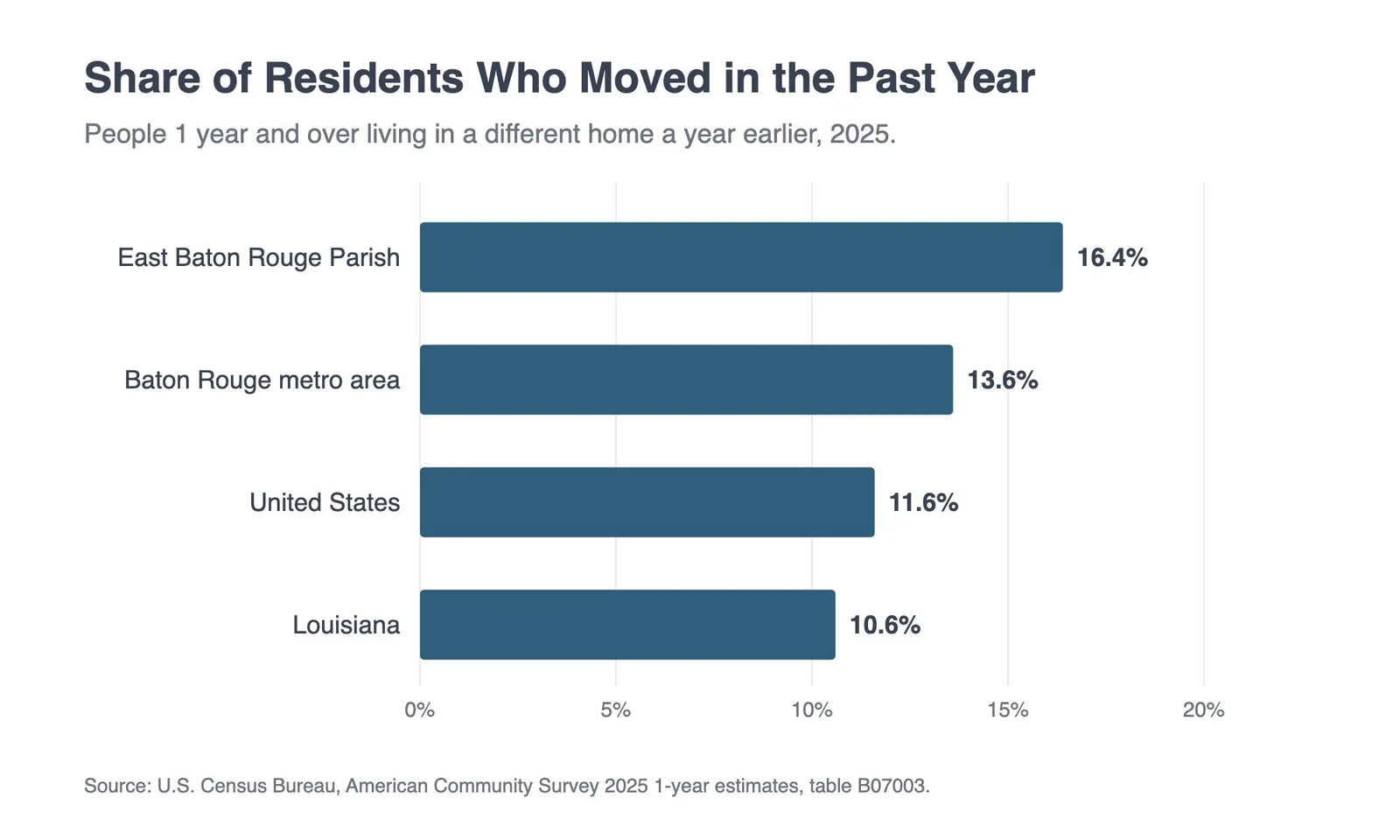
Share of residents who moved in the past year, 2025.
That rate sits well above the comparison areas. The same table puts the Baton Rouge metro area at 13.6%, the United States at 11.6% and Louisiana as a whole at 10.6%.
These are survey estimates, so they carry a margin of error. For East Baton Rouge, the Census Bureau lists a margin of plus or minus 10,900 people on the same-house count, which is enough to move the parish rate a couple of points either way.
Most Moves Stay Close to Home
The parish figure is not mainly about newcomers. Of the 73,948 people who moved, 44,803 moved from somewhere else inside East Baton Rouge Parish, about six in ten by our count.
Another 14,260 came from a different Louisiana parish. The survey counts 11,427 who arrived from another state and 3,458 who came from abroad.
Short moves create their own storage problem. A household moving across town often has a gap between leaving one home and getting into the next, and the furniture has to sit somewhere in between.
Closing dates slip, new leases start on the first of the month, and repairs at the next home can push a move-in back by weeks. Each of those delays turns a one-day move into a stretch of time when belongings have no fixed home.
The metro numbers point the same way. Across the Baton Rouge metro area, the survey counts 119,562 people who lived in a different home a year earlier, by our arithmetic from the same table.
Flood Records Show How Often Homes Get Emptied
Moving is the planned reason to clear out a house. Flooding is the unplanned one, and the Baton Rouge area has a long record of it.
FEMA’s public file of National Flood Insurance Program claims lists claim records by parish and by the year the loss happened. For East Baton Rouge Parish, the file held 22,575 claim records as of September 2026, with 16,514 of them dated 2000 or later.
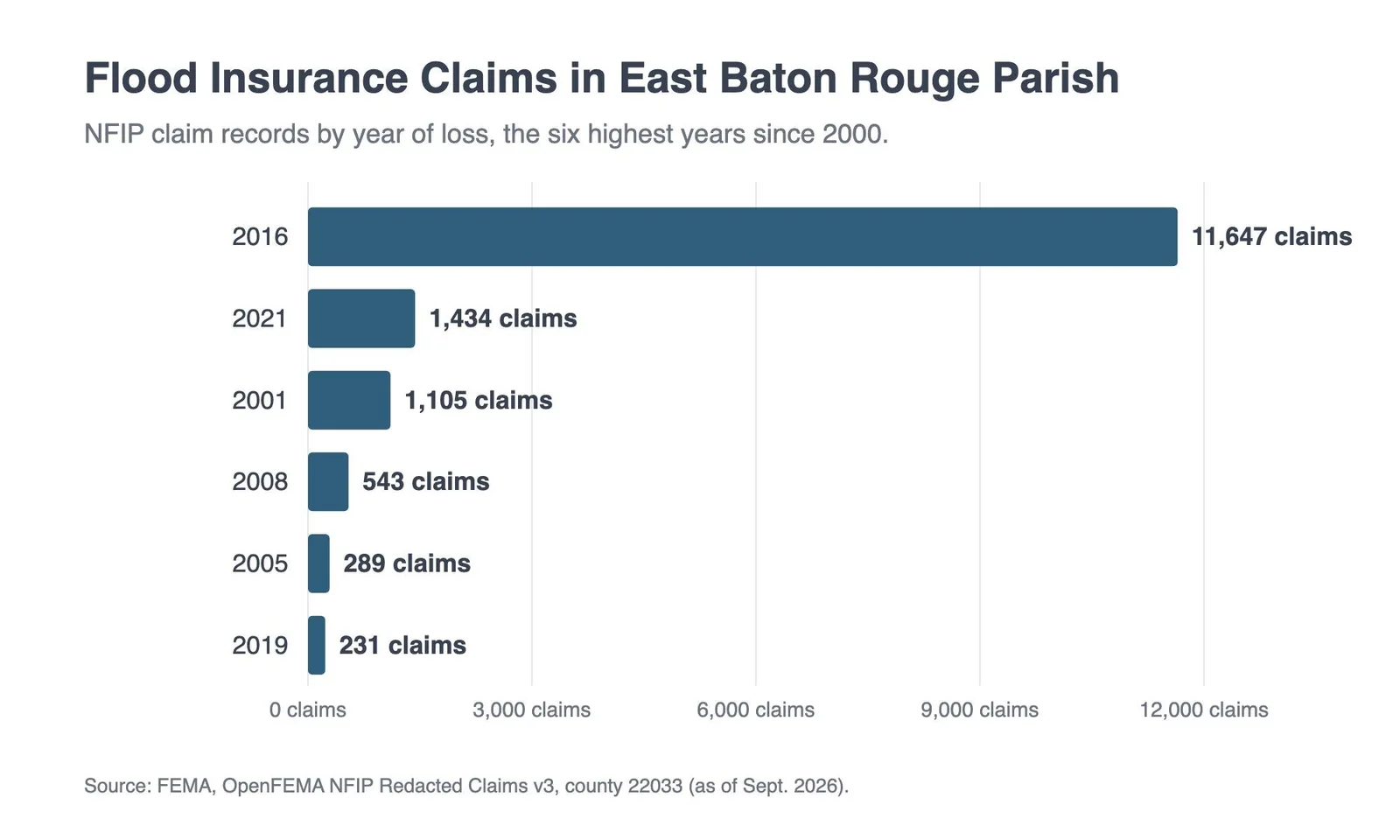
Flood insurance claim records in East Baton Rouge Parish by year of loss.
One year dominates the record. The parish logged 11,647 claims for losses in 2016, about 71% of all claims since 2000 by our arithmetic. Most were tied to the August 2016 event FEMA labels “Mid-summer severe storms.”
That same event produced 7,617 claims in Livingston Parish and 3,872 in Ascension Parish. Across the three parishes, the August 2016 total comes to nearly 23,000.
The flooding did not stop there. East Baton Rouge recorded 1,434 claims in 2021, most of them from storms FEMA files under spring 2021. The 2001, 2008 and 2005 storm years round out the top of the list.
Contents Are Part of the Loss
Flood claims cover two things: the building and the belongings inside it. Of the 11,647 East Baton Rouge claims for 2016 losses, 10,665 show a payment above zero, and 3,987 show a payment for contents.
Those numbers undercount the real picture. The program only covers insured properties, so homes without a flood policy never appear in the file.
For households that do rebuild, the pattern is familiar. Drywall comes out, floors come up, and whatever survived has to leave the house until the work is done.
Renovation and Downsizing Follow the Same Pattern
Planned remodels look a lot like flood repairs from a storage point of view. A kitchen or flooring project usually means emptying rooms that are still full of furniture.
Downsizing runs the other way. An older homeowner moving to a smaller place often needs time to sort what goes, what stays and what goes to family.
In each case, the household has three common choices:
- Pack everything into rooms not under construction.
- Haul belongings to a storage facility and back.
- Keep a container at the property and load it on their own schedule.
Each choice trades space, travel and time differently. Keeping items at the property mainly saves trips, which matters most when a project runs longer than planned.
Storage at the Property
Portable containers are one way households keep belongings on site during a move or repair.
Load and Geaux Portable Storage, a locally owned company in Baton Rouge, describes this approach on Load and Geaux’s on-site storage page. It says its containers are delivered to the customer’s location, where items can be loaded and accessed at the owner’s own pace.
The company lists 16-foot and 20-foot storage boxes, including climate-controlled versions for temperature-sensitive belongings, along with 20-foot and 40-foot shipping containers. It describes the containers as weather-resistant and lockable, and names home renovations and relocations among their uses, for short-term or long-term storage.
What the Numbers Suggest for Local Households
Taken together, the records describe a parish where many homes go through a move or a major repair in any given stretch of years. The 2025 survey alone counts nearly 74,000 residents who moved in a single year.
For a household facing one of those moments, a few questions help sort out storage early:
- How long will the house or room be unusable?
- Which items can handle heat and humidity, and which cannot?
- Is there space on the lot or driveway for a container?
- Will the belongings need to be reached during the project?
Those answers shape the choice more than any single number. The data simply shows that, in East Baton Rouge Parish, the question comes up often.

The macro analyst desk brings highly sought after financial news based on market analysis, insider news and company filings.