

The Baton Rouge area has more warehouses than it did a decade ago. Federal employment data shows a steady rise in warehousing and storage businesses across the parishes around the capital.
At the same time, the federal agency that inspects those buildings has renewed a national program aimed squarely at them. For warehouse operators, that puts an old set of housekeeping rules back in focus.
A Decade of Added Warehouse Sites
The Bureau of Labor Statistics counts employers each year through its Quarterly Census of Employment and Wages. Warehousing and storage has its own industry code, which covers general, refrigerated, farm product, and other storage operations.
In East Baton Rouge, Ascension, West Baton Rouge and Iberville parishes combined, private warehousing and storage establishments rose from 56 in 2014 to 74 in 2024. That is an increase of about 32% by our arithmetic.
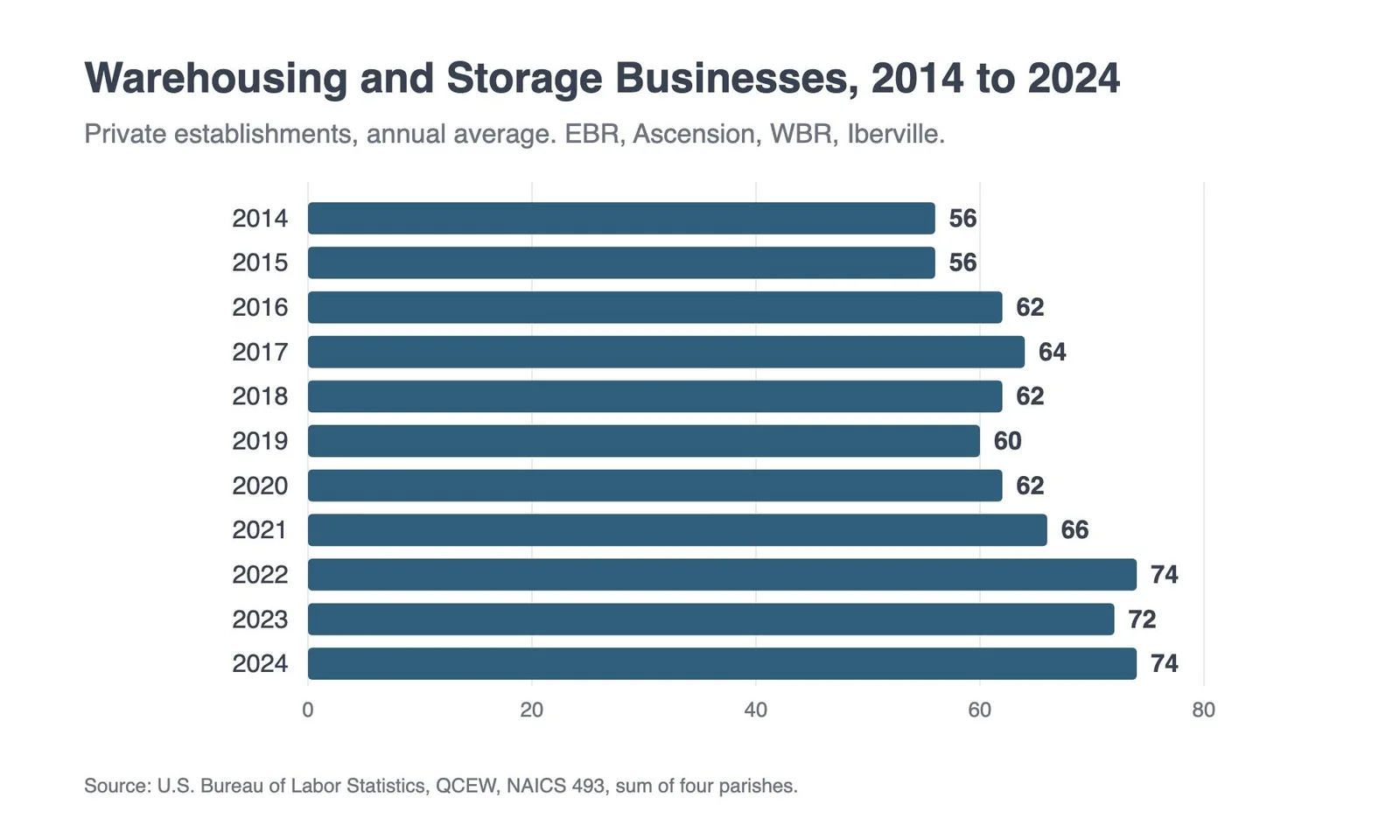
Warehousing and storage establishments in four Baton Rouge area parishes, 2014 to 2024.
East Baton Rouge Parish holds the largest share, with 37 establishments in 2024. West Baton Rouge had 16, Ascension had 12, and Iberville had 9. Livingston Parish is left out because the agency suppresses its figures to protect the privacy of a handful of employers.
Across the full ten-parish Baton Rouge metro area as the agency defines it, the 2024 count was 78.
Growth Tracks the Wider Economy
The rise is real, but it is not unusual for the region. All private businesses in the same four parishes grew from 17,622 establishments to 24,120 over the same decade, an increase of about 37%.
The related trucking sector grew faster. Truck transportation businesses in the four parishes went from 206 to 349, a gain of about 69%.
Employment tells a different story from the building count. Average employment at the four-parish warehouses fell from 1,356 in 2014 to 1,158 in 2024. That works out to about 24 workers per site in 2014 and about 16 in 2024. The data does not explain why.
What OSHA’s Renewed Program Covers
The Occupational Safety and Health Administration describes warehousing as a “rapidly growing, fast-paced industry” on its warehousing and storage safety page. The page lists forklifts, material handling, chemicals, ergonomics, robotics, and slips, trips, and falls among the main hazards.
In July 2026, the agency updated its National Emphasis Program on Warehousing and Distribution Center Operations. The new directive took effect July 31, 2026, replaced the 2023 version, and runs for five years.
Inspections under the program focus on hazards that include “powered industrial vehicle operations, material handling/storage, walking-working surfaces, means of egress, heat, ergonomics and fire protection.” It covers all four warehousing and storage codes, along with postal processing centers and courier operations.
Louisiana does not run its own OSHA State Plan. According to OSHA, private sector workers in the state fall under federal OSHA jurisdiction, so the federal program applies directly here.
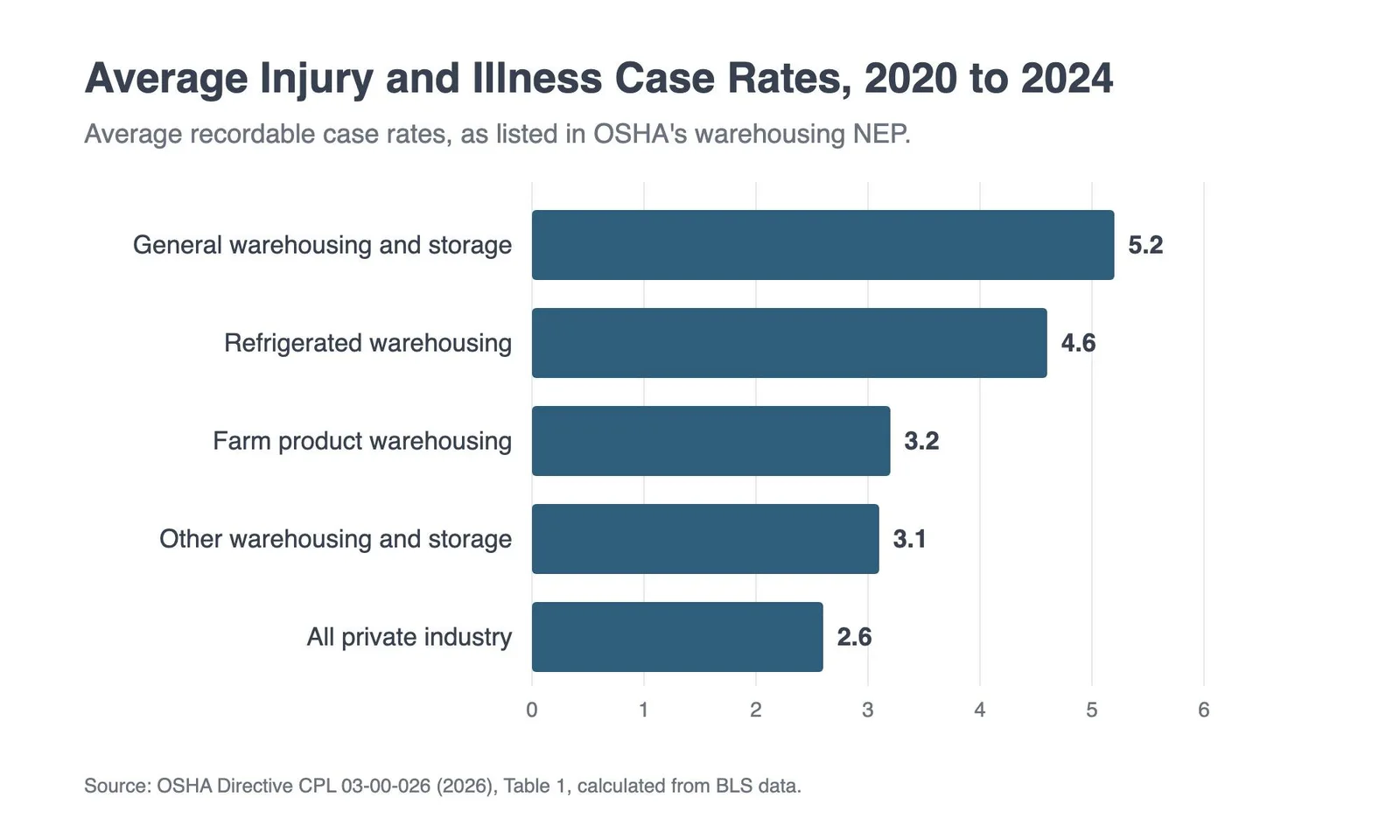
Average recordable case rates, 2020 to 2024, as listed in OSHA’s warehousing directive.
The directive explains the focus with numbers. Its table of 2020 to 2024 averages shows a recordable case rate of 5.2 for general warehousing and storage, double the 2.6 for all private industry.
The Housekeeping Rules in Plain Text
Two sections of federal regulations carry most of the housekeeping duties in a warehouse. Neither one sets a cleaning schedule. Both describe the condition a building has to be in.
The first is 29 CFR 1910.22, the general rule for walking-working surfaces. It requires that “all places of employment, passageways, storerooms, service rooms, and walking-working surfaces are kept in a clean, orderly, and sanitary condition.”
The same section says the floor of each workroom must be “maintained in a clean and, to the extent feasible, in a dry condition.” Surfaces must also be free of hazards such as “sharp or protruding objects, loose boards, corrosion, leaks, spills, snow, and ice,” and inspected “regularly and as necessary.”
The second is 29 CFR 1910.176, which covers materials handling. It says “aisles and passageways shall be kept clear and in good repair,” and that permanent aisles must be marked.
Its housekeeping paragraph is one sentence long. “Storage areas shall be kept free from accumulation of materials that constitute hazards from tripping, fire, explosion, or pest harborage.”
Where the Trouble Usually Starts
OSHA’s guidance for warehouses turns those rules into everyday tasks. Its hazards page tells employers to “keep floors and aisles clear of clutter, electrical cords, hoses, spills, and other hazards that could cause slips, trips, or falls.”
Read together, the rules and that guidance point to a few recurring spots:
- Aisles where forklifts and foot traffic share the same floor.
- Receiving areas and docks, where OSHA suggests filling floor cracks and smoothing transitions.
- Wet areas, where OSHA calls for good drainage, grated floors, platforms, or mats.
- Storage areas, where loose packaging and debris can build up between shifts.
- Permanent aisles, which the rule says must stay clear and marked.
A busy floor can change a great deal between shifts. Because the rules describe a condition rather than a frequency, keeping up is a matter of routine more than any single deep clean.
Who Does the Cleaning
Many warehouses assign floor and aisle cleaning to their own staff, often at the end of a shift. Others bring in an outside janitorial company for scheduled work.
In the Baton Rouge area, Advanced Office Care is one company that describes warehouse cleaning in Baton Rouge on its website. The page notes that floors, aisles, shelving, and loading docks accumulate dust and residue quickly.
The company says it builds customized cleaning plans, uses green cleaning products and schedules work around a facility’s operating hours. It also describes a quality check after each cleaning session and adjusting plans as a site’s needs change.
A Short List for Operators
With more warehouses in the region and a renewed federal program in place, a short review costs little. A practical starting point:
- Walk every aisle and dock and note anything that could cause a slip or trip.
- Check that permanent aisle markings are visible.
- Clear loose packaging and debris from storage areas before it builds up.
- Know where water collects and how it drains.
- Write down who cleans what, and how often.
The rules have not changed much in decades. What has changed in the Baton Rouge area is the number of buildings they apply to.

The macro analyst desk brings highly sought after financial news based on market analysis, insider news and company filings.