

Restaurant waste leaves the kitchen through more than one door.
Most restaurant owners think of waste as one thing: whatever goes in the dumpster out back. In practice, a working kitchen produces at least three separate streams, and each one follows different rules.
Food scraps and packaging go to the dumpster. Used fryer oil goes to a recycler. Grease that slips down the drain ends up in a trap that the city expects to be cleaned on a schedule. Handling those three streams well is one of the less visible parts of running a kitchen, and small habits in each one add up.
Restaurants Produce More Wasted Food Than Any Other Business Type
The national numbers are large. EPA’s wasted food estimates put total wasted food from retail, food service, and households at about 66 million tons in 2019.
Restaurants alone, counting both full-service and limited-service places, generated about 18.3 million tons. That is roughly 27.7 percent of the total, and about twice as much as supermarkets and supercenters.
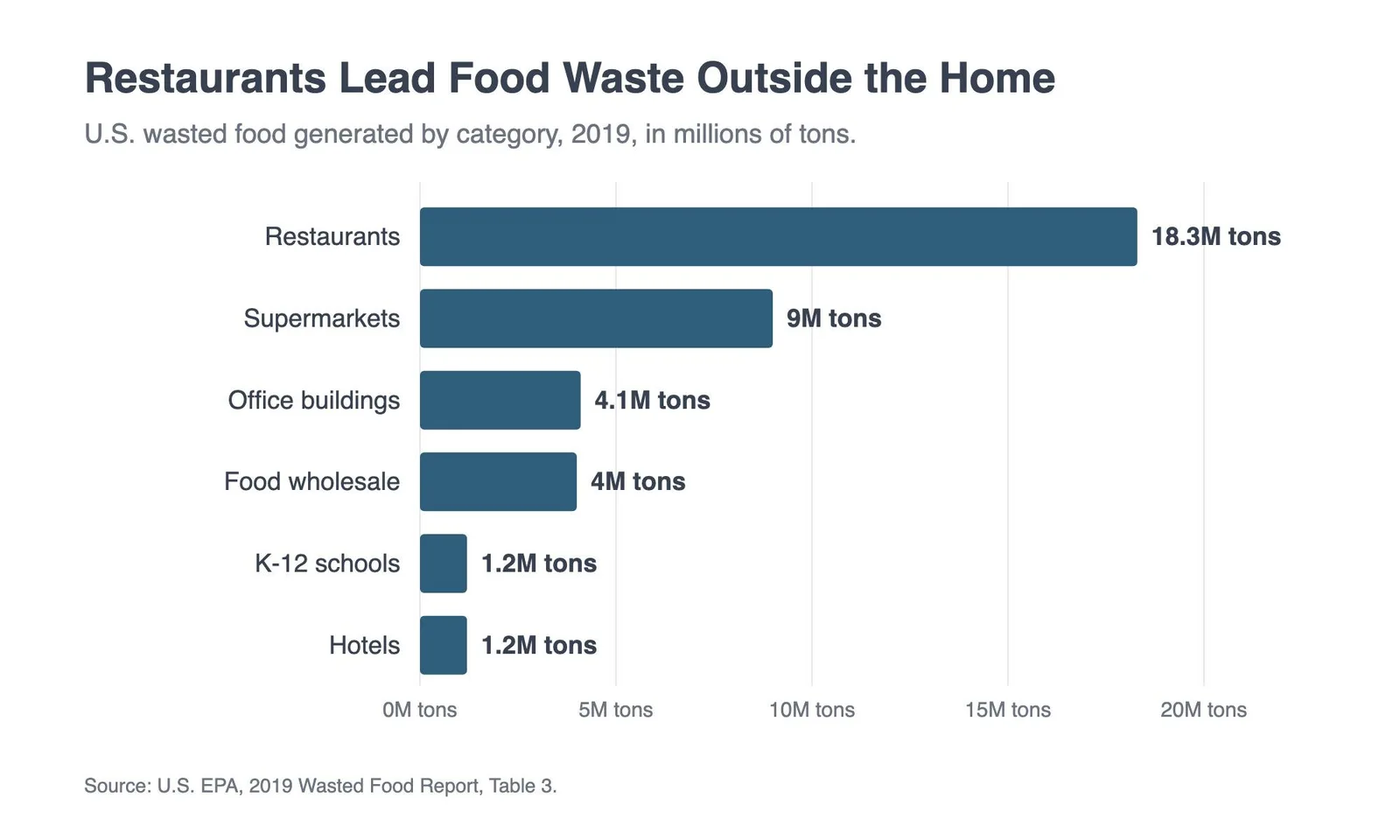
Restaurants generated about twice as much wasted food as supermarkets in 2019.
Households alone produced more. Among businesses and institutions, no other category came close.
Looked at another way, EPA estimates that the food service sector as a whole, which adds hotels, schools, hospitals, offices, and other institutions to restaurants, produced about 40 percent of that 66 million tons. That is about the same share as every household in the country combined, while food retail made up the remaining 20 percent.
Most of It Still Ends Up in a Landfill
EPA also tracks what happens to that food after it leaves the kitchen. Across the broader food service sector, which includes restaurants, hotels, schools, hospitals, and office cafeterias, about 26.7 million tons of food went to waste in 2019.
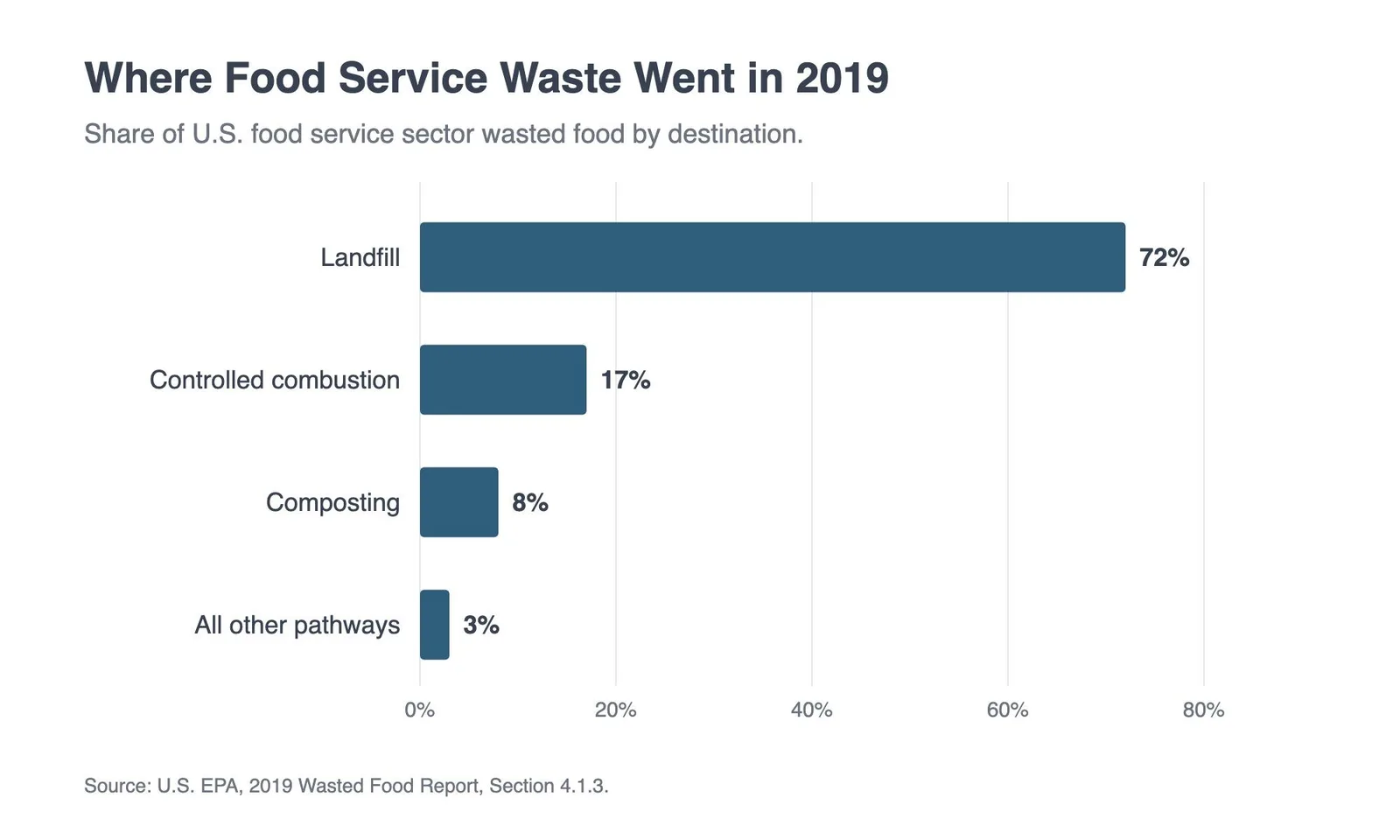
About 72 percent of food service wasted food went to landfills in 2019.
About 72 percent of it was landfilled, 17 percent went to controlled combustion, and 8 percent was composted. For a typical restaurant, that means food scraps are headed out with the regular trash, and the dumpster has to be sized and scheduled to handle wet, heavy, quick-to-smell material.
Stream One: Food Scraps and the Dumpster
Food scraps are among the heaviest parts of a kitchen’s solid waste. They are wet, break down fast in warm weather, and attract pests if they sit too long.
Three habits keep this stream under control:
- Bag wet scraps tightly and keep the dumpster lid closed.
- Pull cardboard out of the trash so the container holds food waste, not empty boxes.
- Match pickup frequency to volume, so scraps leave before they start to smell.
A full dumpster the day before pickup signals the service level is too low. Adding a pickup day often fixes the problem better than a larger container, especially in a tight alley or enclosure.
Stream Two: Fryer Oil Belongs With a Recycler
Never put used cooking oil in the dumpster or down the drain. It is a separate stream, and in many cases it has value.
The City of Baton Rouge’s best management practices for food service establishments tell kitchens to recycle waste cooking oil and note that many waste oil recyclers exist, some of which will pay for the material. Keeping fryer oil in a sealed container for pickup keeps it out of both the trash and the sewer. Label that container clearly and store it away from the dumpster, so no one on a closing shift mistakes it for trash.
Stream Three: The Grease That Goes Down the Drain
The third stream is the one owners notice only when something backs up. Fats, oils, and grease that wash down sinks and dish machines can solidify in sewer lines and cause blockages.
Baton Rouge treats this as a requirement, not a suggestion. According to the city’s guidance, any business that discharges anything other than domestic wastewater needs a pretreatment program, which in food service usually means a grease trap or grease interceptor.
The same guidance spells out the schedule. Grease traps and interceptors must be cleaned at least once every three months, and kitchens should keep a maintenance log showing how often and how much was cleaned. Under-sink traps that are more than half full when cleaned weekly need more frequent service.
The city also asks kitchens to witness every grease trap or interceptor cleaning, so the owner or manager can confirm the device is working properly. A log that lists dates and volumes, kept by someone who watched the work, is the simplest way to show the schedule is being followed.
Small Kitchen Habits That Protect All Three Streams
The city’s practices also point to habits that cost nothing and reduce strain on every stream:
- Dry wipe pots, pans, and dishware into the trash before washing, so less grease reaches the trap.
- Keep sink water below 140 degrees, since hotter water dissolves grease that can harden again further down the line.
- Post “No Oil/Grease” signs above sinks and on the front of dishwashers.
- Train every new hire on where each type of waste goes.
Dry wiping is a good example of how the streams connect. Grease wiped into the trash becomes part of the dumpster load instead of the trap, which can mean less frequent trap cleaning and fewer drain problems.
Putting the Three Streams Together
A kitchen that separates scraps, fryer oil, and drain grease, and keeps cardboard out of the trash, puts less strain on each waste service. The dumpster fills more slowly, the grease trap needs less attention between cleanings, and the oil leaves the building with someone who can use it.
For solid waste, local haulers that offer restaurant dumpster service in Baton Rouge can usually match container size and pickup frequency to a kitchen’s volume. Pairing that with a scheduled grease trap service and an oil recycler covers all three streams that leave a busy restaurant.

The macro analyst desk brings highly sought after financial news based on market analysis, insider news and company filings.