

Federal estimates show Louisiana’s share falling since 2015, while state law sets a ten-year lookback that pauses during pending cases.
Louisiana lost 752 people in traffic crashes in 2024, according to federal estimates. About one in four of those deaths happened in a crash where at least one driver had a blood alcohol concentration of .08 or higher.
That share is lower than it was a decade ago. It is also below the national figure for the same year, which is a change from 2015, when Louisiana sat above it.
What the federal estimates show
The National Highway Traffic Safety Administration publishes a yearly state breakdown drawn from its Fatality Analysis Reporting System. NHTSA’s state alcohol-impaired-driving estimates for 2024, released in July 2026, put Louisiana at 752 traffic deaths for the year.
Of those, an estimated 192 people, or 25%, died in crashes involving an alcohol-impaired driver. In 2015, the state also recorded 752 deaths, and 244 of them, or 32%, fell in that category.
By our arithmetic, that is 52 fewer deaths in alcohol-impaired crashes, even though the state’s total traffic deaths were the same in both years.
Nationally, the share moved the other way. NHTSA counted 39,254 traffic deaths in 2024, with 11,904, or 30%, in alcohol-impaired-driving crashes. The 2015 national share was 29%.
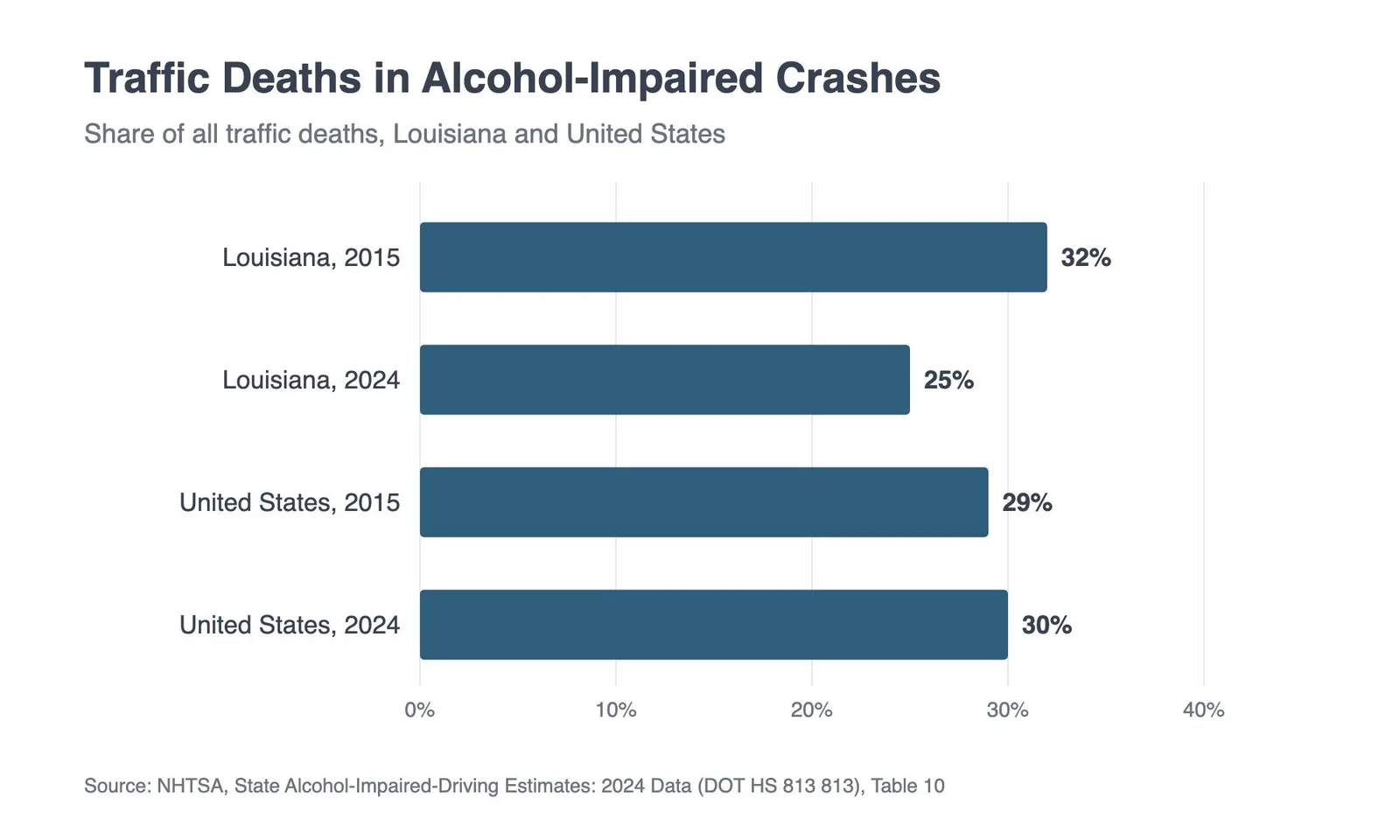
Share of traffic deaths in alcohol-impaired crashes, 2015 and 2024.
How high the readings run
The same tables sort deaths by the highest blood alcohol concentration among the drivers in each crash. In Louisiana in 2024, an estimated 514 deaths involved no alcohol at all.
At the other end, 125 deaths involved a driver at .15 or higher, nearly twice the legal limit. That is 17% of all Louisiana traffic deaths for the year, and about two of every three alcohol-impaired deaths by our arithmetic.
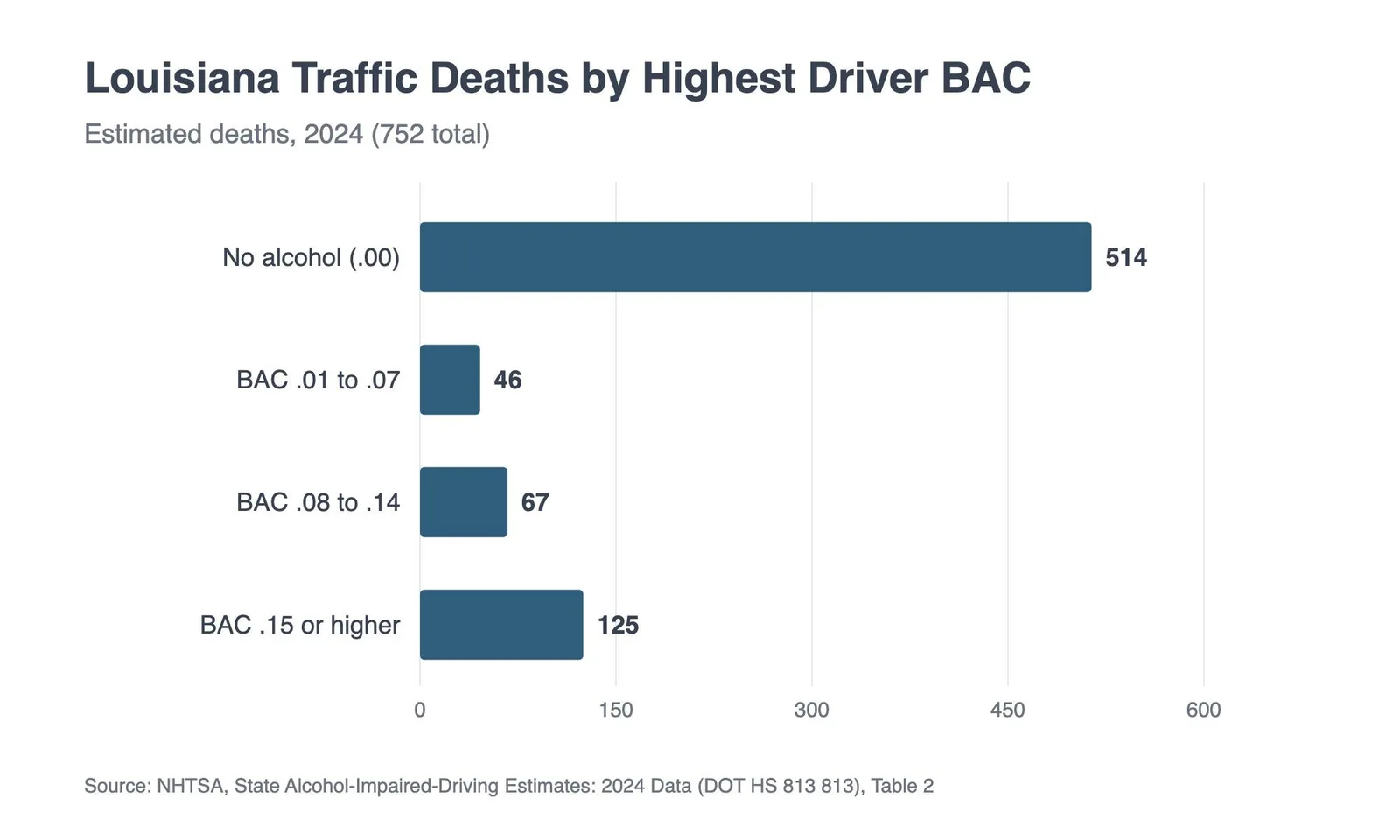
Louisiana traffic deaths by highest driver BAC, 2024.
Why Louisiana’s numbers may be firmer than most
NHTSA warns against reading too much into differences between states. One reason is testing. Many drivers in fatal crashes are never tested, and the agency estimates their readings with a statistical model.
Louisiana tests more than most. Of 1,030 drivers in fatal crashes in the state in 2024, 763, or 74%, had known test results. Nationally, the figure was 20,083 of 55,620 drivers, or 36%. Across the states, the share with known results ranged from 8% in Mississippi to 86% in Montana.
The agency also notes that “alcohol-impaired” describes a driver’s reading, not a finding that alcohol caused the crash.
What Louisiana law covers
The state’s impaired-driving statute, R.S. 14:98, now calls the offense operating a vehicle while impaired. It applies to any motor vehicle, aircraft, watercraft, vessel, or other means of conveyance.
The offense is met in several ways. A driver may be impaired by alcohol, have a blood alcohol concentration of 0.08 percent or more, or be impaired by drugs or a mix of drugs and alcohol. A valid driver’s license is not an element of the crime, and lacking one is not a defense.
Penalties for a first offense are in a companion section, R.S. 14:98.1. It sets a fine of $300 to $1,000 and jail time of 10 days to six months.
That sentence can be suspended only if the court places the person on probation with set conditions. They include 48 hours in jail or at least 32 hours of court-approved community service, a substance abuse program, a driver improvement program, and no driving for at least six months unless the vehicle has an ignition interlock device.
A reading of .15 or more but under .20 changes that. At least 48 hours of the sentence must then be served without parole, probation, or suspension, on top of the other jail time.
The ten-year lookback and pending cases
Repeat offenses carry steeper penalties, so the statute spells out what counts as a prior conviction. In general, a conviction more than ten years before the new offense does not count.
The clock does not always run, though. R.S. 14:98 excludes from the ten-year period any time a person spent awaiting trial, under an order of attachment for failure to appear, on probation or parole for one of these offenses, or incarcerated.
In practice, a case that stays open for a long time, or a missed court date that leads to an attachment, can keep an old conviction inside the window.
The law adds a separate rule for children. When a child 12 or younger was a passenger, the minimum mandatory sentence cannot be suspended. Lawmakers also declared that a third or later conviction is presumptive evidence of a substance abuse disorder.
After an arrest
An impaired-driving arrest usually starts with booking and a bond decision. QRF Bail Bonds, a licensed, veteran-owned bail company in Walker, describes that process on its website.
The company says bond amounts depend on factors such as prior arrests, the blood alcohol reading, any crash involvement, and parish bond schedules. It says release times vary with the parish, the jail’s booking workload, and any detox requirement.
The same page states that refusing a breath test does not by itself block release on bond, though it can affect the charges and license penalties. Families can submit the needed information online through a secure form.
A few points worth keeping
- Louisiana’s share of traffic deaths in alcohol-impaired crashes fell from 32% in 2015 to 25% in 2024, by NHTSA’s estimates.
- High readings make up most of that total. Crashes with a driver at .15 or more account for 125 of the state’s 192 alcohol-impaired deaths in 2024.
- Louisiana tests a much larger share of drivers in fatal crashes than the nation as a whole, which makes its estimates less dependent on modeling.
- Under state law, the ten-year lookback for prior convictions pauses while a case is pending or a failure-to-appear attachment is open.
The federal data covers deaths, not arrests, and it does not break results down by parish. For anyone dealing with a case now, the statute and the court’s own instructions are the place to start.

The macro analyst desk brings highly sought after financial news based on market analysis, insider news and company filings.