

The fastest-growing version of adventure travel is not necessarily harder, riskier or more remote. It is more accessible, more comfortable and easier to combine with the rest of a traveler’s life.
Soft adventure is widening the market for active travel by combining outdoor experiences with social connection and comfort. Photo: Altitonantis, CC0. Source: Wikimedia Commons.
Adventure travel used to be easy to picture. It meant a summit, a long trek, a raft, a tent, a difficult road or some other experience that required physical effort and a willingness to be uncomfortable.
That version of the industry still exists, but it no longer defines the whole category.
A large and commercially important part of adventure travel is moving in the opposite direction. Travelers still want hiking, cycling, wildlife, water activities and time outdoors, but they increasingly want those experiences paired with good accommodation, reliable logistics, local food, free time and a reasonable level of comfort.
The industry has started calling this “soft adventure.”
The phrase can sound like a contradiction, but from a business perspective it solves a major problem: it expands the addressable market for active travel without removing the sense of discovery that makes adventure valuable in the first place.
Adventure without hardship
KAYAK’s 2026 travel trend research captures the shift clearly. One in four travelers in its study said they mix light adventure with relaxation, choosing activities such as hiking, cycling or paddleboarding while leaving room for rest. Another 23% identified themselves as adventure and nature seekers.
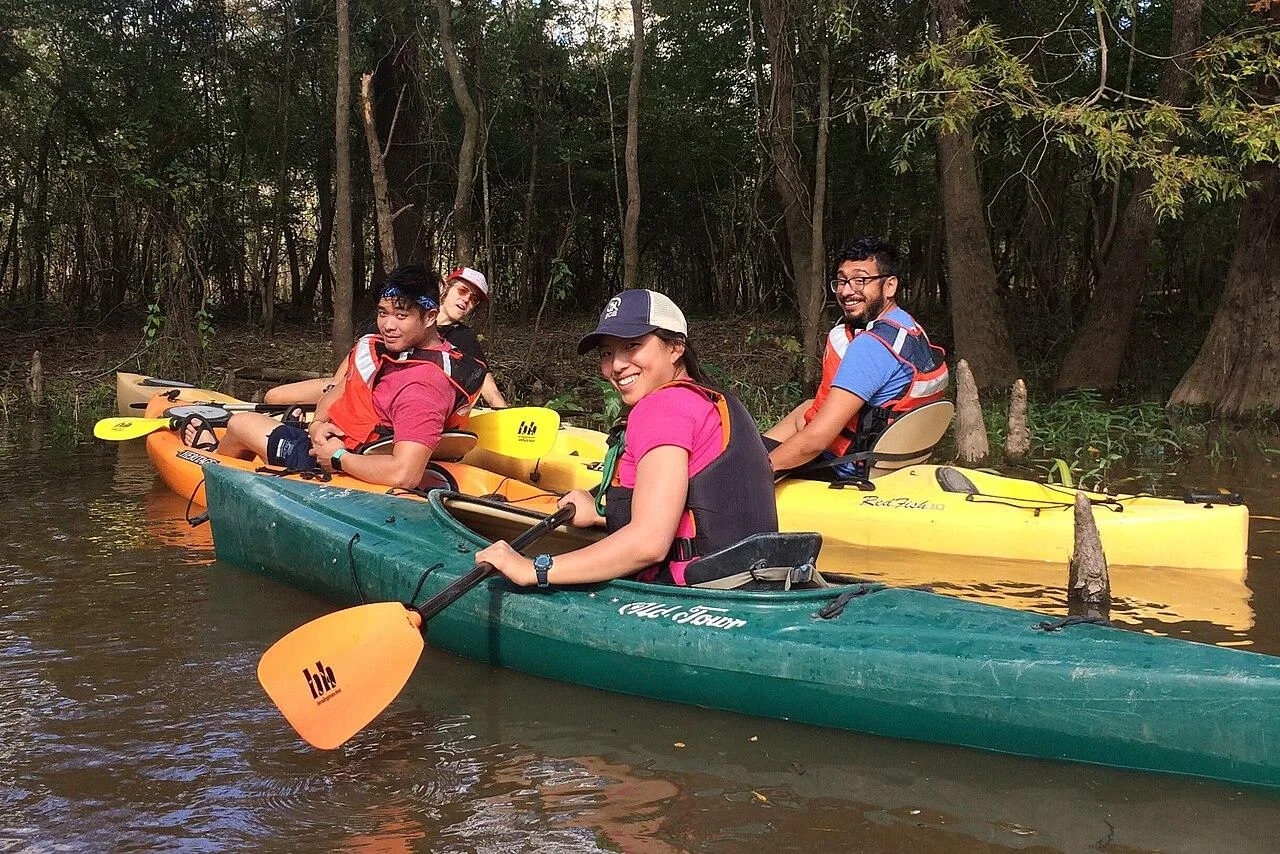
Kayaking is a classic soft-adventure activity: active and outdoors, but accessible to travelers who are not seeking an expedition. Big Thicket National Preserve, Texas. Photo: NPS, public domain. Source: Wikimedia Commons.
The comfort side of the equation is just as important. KAYAK reported that bookings for “trendy hotels” were up 223% year over year in the period it analyzed, while searches for amenities such as better towels and linens also increased.
In other words, the traveler interested in a morning hike may be the same traveler who wants a comfortable bed, a spa treatment and a good dinner that evening.
This changes how the industry should think about adventure customers. They are not a small tribe of extreme athletes. They increasingly include couples, families, solo travelers, older travelers, remote workers and people who are physically active but do not want every vacation to feel like an expedition.
The product becomes less about proving endurance and more about combining movement, nature and cultural access.
Why the economics are attractive
The Adventure Travel Trade Association’s 2026 industry report suggests that this broader market can be economically resilient.
Nearly 60% of adventure travel operators surveyed reported revenue growth in 2025. The median price of an operator’s most popular itinerary was $2,250 for seven nights, and 61% of respondents said they expected higher net profits in 2026.
Those numbers do not describe a mass-market product built around the lowest possible price. They describe a category where travelers are willing to pay for expertise, logistics, smaller groups and access.
The structure also matters locally. ATTA estimates that roughly 75% of adventure trip revenue remains in the local economy. That is unusually important in tourism because adventure itineraries often use local guides, small accommodations, transport providers, restaurants and activity operators across several communities instead of concentrating all spending in one resort.
The industry is also becoming more disciplined.
ATTA President Gustavo Timo summarized the direction this way: “success in today’s market is not about running bigger trips, it is about running better ones.”
That is a useful description of the business model. A smaller departure with a higher-quality itinerary may generate better margins, stronger reviews and more repeat business than a large group sold primarily on price.
Smaller groups change the product
Group size is one of the most important variables in soft adventure.
A twelve-person hiking group can use trails, restaurants and locally owned hotels that would be difficult for a forty-person coach group. A small group can change pace when the weather changes, stop at a village, add a local guide, or spend more time at a wildlife sighting without throwing an entire schedule into chaos.
That flexibility has economic value because it lets operators build more differentiated products.
It also reduces the distance between “guided” and “independent” travel. Many travelers do not want to be managed from breakfast to bedtime. They want the difficult parts — transport, permits, route planning, safety, local coordination — handled for them while preserving enough free time to feel they are still making their own trip.
Soft adventure fits that preference.
The operator provides structure where structure is valuable and leaves space where freedom is more valuable.
That is a different product from both the old coach tour and the self-organized backpacking trip. It sits between them, which helps explain why it can appeal to a much larger audience.
Comfort is no longer the opposite of adventure
For years, travel marketing often treated comfort and adventure as competing ideas. The more authentic the adventure, the rougher the conditions were supposed to be.
That assumption is weakening.
A traveler can hike a volcano and sleep in a comfortable hotel. They can kayak in the morning and book a tasting menu at night. They can take an e-bike through a rural region without being an elite cyclist. They can spend a day on a trail and the next day at a spa.
From a commercial perspective, these combinations are powerful because they allow operators to add value without simply adding more distance or difficulty.
They also create more ways to segment customers.
A traditional adventure company might have sold one trekking itinerary at three levels of difficulty. A modern operator can sell nature plus wellness, hiking plus gastronomy, cycling plus wine, wildlife plus photography, or culture plus light activity.

Soft adventure increasingly combines activity with cultural access; a bicycle tour through Bangkok’s neighborhoods is one example. Photo: David McKelvey, CC BY 2.0. Source: Wikimedia Commons.
Each combination gives the traveler a clearer reason to choose one itinerary over another.
This is important in a market where online distribution makes basic itineraries easy to compare. Differentiation becomes less about whether a tour visits a famous destination and more about how the days are designed.
Soft adventure can therefore support higher-value positioning without requiring conventional luxury.
The premium is not necessarily a five-star hotel. It may be a better guide, fewer people, a smoother transfer, a locally owned lodge, more thoughtful pacing or access to an experience that would be difficult to organize independently.
Destinations outside the usual circuit may benefit
The soft-adventure model also changes which destinations can compete.
ATTA’s 2026 research lists Northeast Asia and Scandinavia among the trending regions and notes growing interest in customized trips, low-impact itineraries, women-focused travel and expert-led experiences.
These are not all destinations built around conventional resort tourism.
Outdoor travel can direct demand toward rural regions, secondary cities and protected landscapes that have strong natural assets but limited large-scale tourism infrastructure. In some cases that is an advantage. Small-group travelers do not require the same volume of hotel rooms, coach parking or large attractions as mass tourism.
The economic opportunity, however, comes with limits.
Nature-based destinations can be damaged quickly if growth outruns trail capacity, waste systems, local housing or water supply. Soft adventure should not become a softer marketing term for sending unlimited numbers of visitors into fragile places.
The strongest operators will need to manage seasonality, group size and route selection as carefully as they manage sales.
That is also where local partnerships become a competitive advantage. A company that knows when a trail is crowded, which family lodge can handle a group, where road conditions change, or which guide has specialist knowledge can build a better product than a platform relying only on public data.
Technology is becoming part of the margin equation
The customer may want nature and spontaneity, but the business behind the trip increasingly depends on technology.
Adventure itineraries are operationally complicated. A single trip can involve flights, hotels, transfers, guides, equipment, activity providers, park access and weather-sensitive schedules. The more components involved, the more opportunities there are for cost leakage, manual work and errors.
For small operators, this has historically limited scale.
They could design excellent trips but still rely on email, spreadsheets and manual confirmations to sell them. That makes it harder to update prices, distribute inventory or respond quickly when demand changes.
The commercial opportunity now is not simply to put adventure tours online. It is to connect the pieces well enough that a traveler can compare and book them without the operator rebuilding the trip manually each time.
This is one reason dynamic packaging is starting to matter more in guided travel. If multi-day inventory can be connected with flights and other trip components, a traveler can evaluate the real cost of the journey rather than comparing a tour price that excludes the transport needed to reach it.
That kind of infrastructure may be especially useful for soft adventure because the customer is often choosing among several destinations that can satisfy the same goal. Someone looking for a week of hiking, local food and comfortable lodging might reasonably compare Mexico, Peru, Japan, Portugal or the Balkans.
The easier those options are to price as complete trips, the more competitive the category becomes.
What this looks like in practice
Travel companies are beginning to merchandise trips less by destination alone and more by the kind of experience a traveler wants to have.
That matters for soft adventure because the category increasingly overlaps with culture rather than sitting only in the outdoors. A traveler may want a light hike or scenic route, but the value of the trip can come just as much from local food, history, community interaction, traditional crafts or having a guide explain a place that would be difficult to understand independently.
Vibe Adventures, for example, organizes multi-day journeys under its In-Depth Cultural tours collection, bringing together itineraries built around local history, traditions, food, communities and cultural sites rather than a single geographic theme. The company’s broader packaging platform also connects guided multi-day trips with flights, so the travel style can become the starting point for building a complete journey rather than simply choosing an isolated activity.
The important part is not the label on the page. It is the buying logic behind it.
A traveler who starts with “I want to understand a place more deeply, meet local people and have the difficult logistics handled for me” is expressing a different intent from someone who starts with “I want to go to Country X.” Travel companies that respond to the first type of intent have more room to recommend destinations, departure dates and trip formats that the traveler may not have considered independently.
That experience-first approach can also widen the commercial value of soft adventure. Culture, food and local interaction give operators ways to differentiate an itinerary without making it physically harder or more luxurious. A moderate walking route, for example, becomes a different product when it includes a specialist guide, a community visit, a regional meal or access to a cultural tradition tied to the landscape.
It also gives smaller destinations a way into the consideration set. They do not have to be famous enough to generate demand by name if they can deliver the kind of cultural depth, activity level and guided access the traveler is already looking for.
What soft adventure signals about the next travel cycle
The soft-adventure trend is not really about making adventure easier. It is about making active travel relevant to more people.
The data points in the same direction from two sides. Consumer research shows travelers want light activity combined with comfort. Operator research shows adventure businesses are focusing on smaller groups, higher-quality products, stronger margins and more disciplined growth.
Those trends reinforce one another.
As the category expands, the winners are unlikely to be the companies that make every trip more extreme. They will be the ones that make complicated experiences easier to buy, operate them well, and preserve enough local character that the journey still feels worth leaving home for.
The business model works because it does not ask travelers to choose between adventure and comfort.
It sells both.

The macro analyst desk brings highly sought after financial news based on market analysis, insider news and company filings.