

A review of 13 trash bin cleaning websites found operators split between advertising freedom and requiring a minimum, and one doing both at once.
By Clint Sanchez
Subscription billing has moved well beyond software and streaming. Lawn treatment, pool care, pest control and curbside trash bin cleaning are now commonly sold as a recurring charge to a card on file, signed up for on a phone in a couple of minutes.
The companies selling these services are often one or two people. They write their own website copy, choose their own terms, and decide for themselves how to describe what a customer is agreeing to.
Looking closely at how one small category does it shows a split, and a gap that matters more than the wording of any single promise.
What the sites say
In October 2026 I reviewed the home and pricing pages of 13 trash bin cleaning operators in at least ten states and recorded what each one told a prospective customer about staying and leaving.
Six of the 13 advertised no contracts, or no long-term contracts. Five stated a minimum number of cleanings. Three mentioned that a customer could pause or skip a visit.
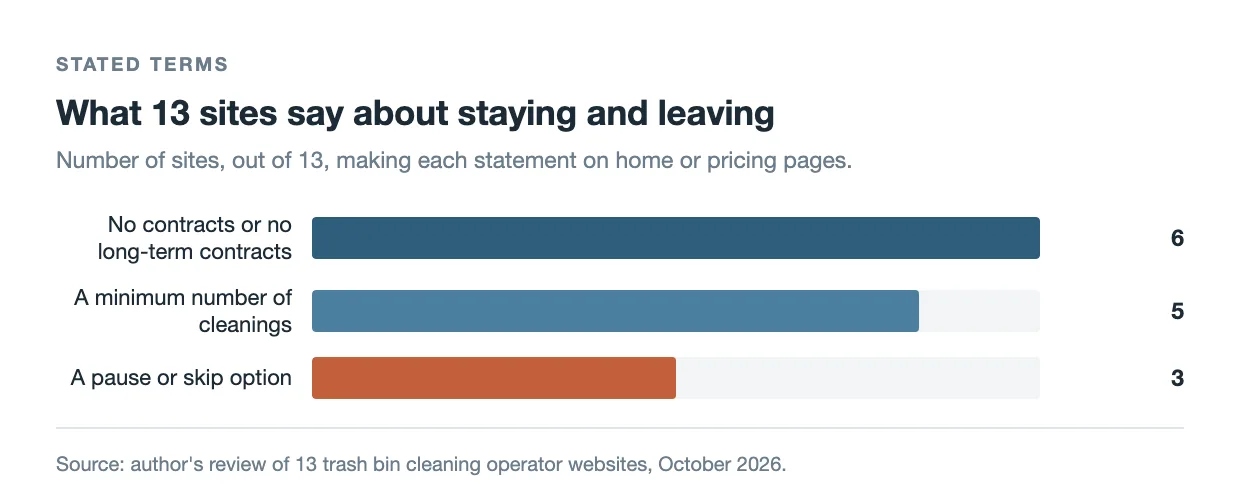
Operators are split on commitment, and most are silent on pausing.
The minimums were consistent. Four of the five set it at three cleanings. The fifth set it by the year, at ten cleanings for a monthly plan.
The economics behind a minimum
A minimum has a practical basis in this business. The first cleaning of a garbage can that has never been washed is the dirtiest job the operator will do at that address.
An operator who charges the same price for every visit earns the least on the first one. A customer who cancels after one cleaning has bought the hardest visit at the average price.
Routes are also planned in advance. A stop added for a single visit and then removed costs drive time that a recurring stop spreads across months. A three-visit minimum is the operator’s way of pricing that in without raising the headline rate.
When both messages appear together
One of the 13 sites advertised no contracts and listed a three-visit minimum on the same site.
The operator probably sees no conflict. To an operator, a contract may mean an annual agreement, and three visits is not that. A customer reads it differently. A person who signs up under a banner promising no contracts and is then told they owe two more visits is likely to feel misled, and a customer who feels misled tends to leave with a complaint attached.
The fix costs nothing. An operator with a minimum can state it next to the price and drop the competing claim. An operator without one can say so. The problem is only in saying both.
The rules are in motion
Recurring billing terms are an area regulators have been actively rewriting, and small operators are not exempt from the results.
The Federal Trade Commission’s Negative Option Rule page records the sequence. The agency announced a final rule widely known as click-to-cancel in 2024. In February 2026 it published a revision of the rule to conform it to federal court decisions, and in March 2026 it opened a new advance notice of proposed rulemaking and asked for public comment on negative option marketing practices.
The details of what will be required are therefore unsettled. The direction of the discussion is not. It concerns clear disclosure of terms before a customer is charged and a cancellation process that is not harder than signing up. A small operator who states the minimum beside the price and tells customers how to cancel is aligned with that direction whatever the final text says.
State laws on automatic renewal add another layer and vary widely. An operator serving customers in more than one state should not assume the rules match.
The option most sites leave out
The count that deserves the most attention is the smallest one. Only three of the 13 sites told a customer that service could be paused.
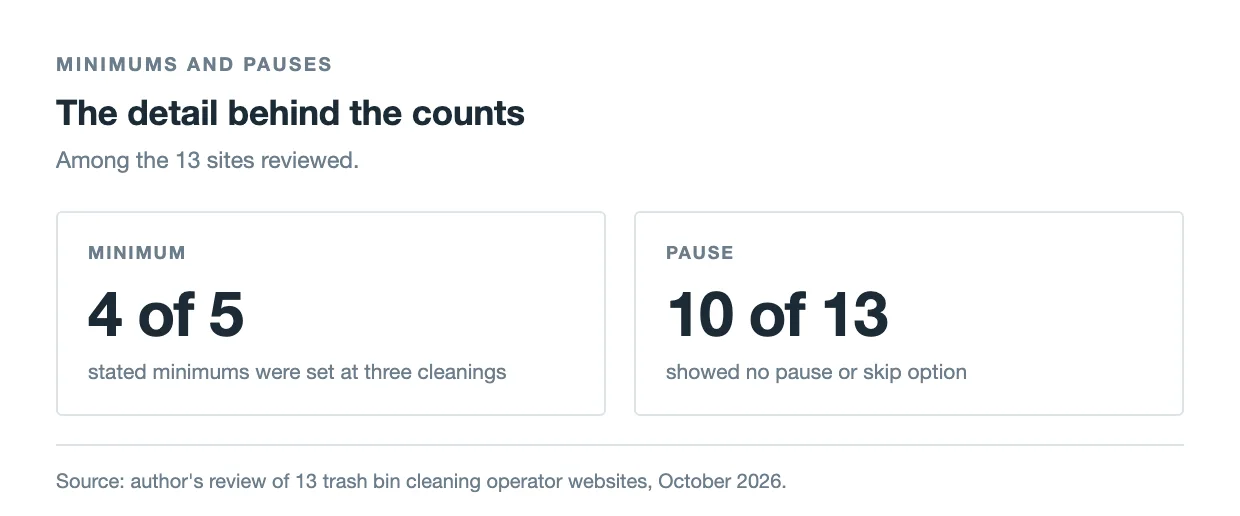
Three cleanings is the usual minimum. A visible pause option is unusual.
On the other ten, the only exit a customer can see is cancellation. That matters in a seasonal business. Garbage cans smell less in cold weather, and in northern markets the water freezes. A household that wants to stop for three months has a reasonable request and, on most of these sites, one way to express it.
One operator in the review handled this directly. Its site explains that remaining cleanings on a subscription are placed on pause when the weather drops below freezing and that the schedule reopens when conditions allow.
A pause keeps the customer on the list with an expected return. A cancellation removes them, and bringing them back becomes a new sale. The reasons subscribers leave this kind of service, and the messages that bring them back, are covered in this analysis of why bin cleaning customers cancel and how operators win them back.
How cancellation is described
Few of the sites reviewed explained how to cancel. One told customers to call or email. Another stated that after the third visit a customer could cancel according to its notice terms.
Silence on the point is not the same as making cancellation difficult, and a small operator may well handle it by phone or text without friction. A customer deciding where to sign up cannot see that. A single sentence explaining how to stop would answer a question most of these pages leave open.
Messages sent after a customer leaves are regulated as well. The FTC’s compliance guide for the CAN-SPAM Act says marketing email must include a clear explanation of how to opt out, and that opt-out requests must be honored within 10 business days. A win-back email to former subscribers falls under that requirement.
Limits of the review
Thirteen sites is a small sample and was not randomly selected. The counts come from each operator’s home and pricing pages as they stood in October 2026. Terms that appear only inside a signup form or on a separate policy page were not counted, so some operators may disclose more than these figures suggest.
The review also could not measure outcomes. It does not show that sites with a pause option keep more customers, only that most do not offer one in view.
A pattern beyond one niche
The same three choices face every small business that bills on a recurring basis: commit to a minimum or not, say so plainly or not, and offer a way to stop temporarily or not.
In this category, the first choice is split almost evenly, the second is handled inconsistently, and the third is mostly overlooked. As regulators continue to work on recurring billing and more household services move to subscriptions, the operators who state their terms in one consistent sentence are likely to have the least to change.
Disclosure: The author owns a marketing agency that builds websites and marketing systems for service businesses, including trash bin cleaning companies, and published the page linked from this article.

The macro analyst desk brings highly sought after financial news based on market analysis, insider news and company filings.