

For years, the gut-brain axis lived in an awkward place in health culture. It was popular enough to show up in podcasts and supplement ads, but fuzzy enough that serious readers were never sure what to believe. The past few years have brought a noticeable shift. The conversation is moving from catchy metaphors to measurable pathways, better study design, and a clearer sense of what is still uncertain.
That is the real headline in gut-brain axis research right now. Not that the gut “controls” the mind, or that mood is “just” a microbiome issue. Instead, the field is tightening its definitions and focusing on specific communication routes that connect digestion to the brain, including nerve signaling, immune signaling, and microbial metabolites that circulate through the body.
This is a digestive story first. The gut is a sensory organ, an immune organ, and an ecosystem. It processes food, hosts trillions of microbes, and constantly reports status updates to the nervous system. When that reporting system is noisy, inflamed, or disrupted, some people experience the consequences as gut symptoms, and some experience them as mood changes, sleep disruption, brain fog, or stress sensitivity.
The gut-brain axis is not one pathway
A useful way to understand the gut-brain axis is to stop imagining a single “wire” between the belly and the brain. It is better described as a network with a few major highways.
One highway is the vagus nerve, a primary communication route between the gut and the brain. Modern reviews describe vagus nerve signaling as heavily implicated in the regulation of anxiety and depression related circuits, learning, memory, and motivation, which helps explain why digestion can feel emotionally loud for some people.
Another highway is the immune system. The gut is a major immune interface, and the immune signals produced in response to stress, infection, or dysbiosis can influence brain inflammation and brain function.
A third highway is chemical messaging. Gut microbes produce metabolites that can influence gut lining integrity and systemic inflammation, and bile acids and other digestive chemicals can also act like signaling molecules.
The key point is that mood changes linked to digestion do not require a magical explanation. They can arise from normal biology running under strain.
Why does the field feel louder right now
The rise in attention is not only on social media. It is partly because the research has matured.
Newer work increasingly ties gut differences to measurable brain or behavior outcomes while acknowledging the limits of correlation. For example, a 2025 Nature Communications study linked childhood gut microbiome patterns with internalizing symptoms and brain connectivity features, while still treating the result as an association that needs careful interpretation.
At the same time, mainstream medical institutions have started translating the topic for the public. Harvard Health describes how the gastrointestinal tract is sensitive to emotion and how the gut and brain communicate, which is a useful bridge between lived experience and physiology.
There is also a practical reason. Many people have overlapping digestive symptoms and anxiety or low mood, especially in conditions like IBS. Reviews of IBS increasingly frame it as a disorder of gut-brain interaction rather than a purely local bowel problem.
The trend that matters most is more precision and more skepticism
One of the healthiest developments in the field is that it is getting more rigorous and more self-critical.
A good example is the difference between the gut microbiome story and the “brain microbiome” story. Some headlines have implied that microbes live in healthy brains the way they live in the gut. But critics have argued there is little credible evidence for a stable brain microbiome in healthy humans and that contamination can explain many findings.
That debate is not a reason to dismiss the gut-brain axis. It is a reason to treat extraordinary claims as extraordinary, and to keep the focus on pathways that have a stronger grounding, like gut-derived immune signals, vagal signaling, and microbial metabolites affecting the body from the gut outward.
This is the new posture of gut-brain axis research. More humility, tighter methods, and clearer separation between what is known, what is plausible, and what is hype.
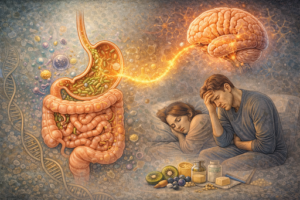
How digestive health can influence mood in real life
The gut-brain axis becomes easiest to understand when it is framed as everyday scenarios rather than abstract theory.
Consider three common patterns.
A stress gut loop
A person goes through a stressful month. Their sleep gets shorter, meals become irregular, and caffeine goes up. They start feeling bloated and urgent after meals. Then they start feeling anxious about being away from a bathroom. The anxiety tightens the gut, the gut discomfort increases anxiety, and a loop forms. Harvard Health describes this kind of two-way relationship, where emotions trigger gut symptoms and gut symptoms feed back into the emotional state.
A post-infection shift
After a stomach bug, some people report that digestion never fully returns to baseline. They become more sensitive to certain foods, and their mood becomes more reactive. In the gut-brain framework, a post-infection period can change gut microbes, immune tone, and gut sensitivity, which can change stress responses. The mechanism differs person to person, but the pattern fits the idea of bidirectional signaling.
A long-term condition with mixed symptoms
IBS is a clear example where gut symptoms and mental health symptoms often overlap. A 2025 review on the gut-brain axis in IBS highlights microbiota neuroimmune interaction and disturbance to the gut-brain axis as part of the condition’s framework.
None of these examples requires claiming that the gut is the single cause of depression or anxiety. They show how digestive function can shape the body’s stress load, which can shape mood.
Where diet fits in the most evidence-informed way
Diet is often described as if it directly “feeds happiness.” That framing is too simple. Diet shapes the gut environment, which can influence immune activity, gut barrier function, and microbial metabolites. Those factors can influence how resilient someone feels under stress and how reactive their gut becomes to everyday life.
Recent popular reporting often emphasizes that processed patterns can be associated with less microbial diversity and more inflammatory signatures, while whole food patterns tend to support diversity. It also emphasizes that early clinical trials on probiotics show mixed but sometimes promising signals for mood symptoms, with a clear message that more rigorous research is needed.
The more realistic view is this.
Dietary changes are best treated as supportive levers. They can reduce symptom burden and improve steadiness for some people. They are not a replacement for mental health care when depression or anxiety is significant.
The emerging interventions are more medical than most people expect
The public conversation often focuses on probiotics. The research conversation is broader.
There is interest in targeted probiotics, prebiotics, precision dietary modulation, and even fecal microbiota transplantation in narrow contexts, but much of that remains investigational for mental health outcomes. A 2025 Frontiers review discusses microbiome-targeted interventions and evaluates current findings linking dysbiosis to psychiatric conditions, while still treating the therapeutic landscape as evolving rather than settled.
There is also interest in vagus nerve-related interventions. A 2024 review discusses interactions between vagus nerve stimulation and gut microbiota, framing VNS as a way to modulate gut-brain axis signaling in neuropsychiatry while acknowledging complexity.
This is another sign of the field’s maturation. The gut-brain axis is being studied as biology, not only as nutrition advice.
What to do with this information without turning it into a lifestyle obsession
The best use of gut-brain axis research is not to chase perfect gut purity. It is to make a few high-yield changes that reduce background stress on the digestive system, then see what actually changes.
Regular meals and predictable meal timing
Irregular eating can amplify gut sensitivity for many people and make stress loops worse
Fiber and plant variety increased gradually
A sudden fiber jump can worsen symptoms in the short term for sensitive guts, while gradual increases are often better tolerated
Sleep and stress hygiene
Sleep disruption can worsen both digestion and mood. The gut-brain axis works both ways, so stabilizing sleep is not a soft suggestion. It is physiology.
If symptoms are intense, treat red flags seriously
Severe weight loss, blood in stool, persistent fever, progressive swallowing problems, or severe depression with functional impairment should prompt medical care rather than self-experimentation
If you want a grounded overview of the gut-brain connection from a major medical outlet
Harvard Health on the gut-brain connection.
If you want a modern digest of where the science is pointing, including how it shows up in conditions like long COVID, anxiety, and neurodegenerative disease discussions
Stanford Medicine on what the science says.
If you follow metabolic and digestion educators like Dr. Berg, and want a general hub for digestion-related reading that connects food patterns and gut signals.
Closing perspective
The gut-brain axis is no longer just a catchy phrase. The field is moving toward more precise models that connect digestion, nerves, immune signaling, and microbial metabolites into a bidirectional network.
The most responsible takeaway from gut-brain axis research is also the most useful. Digestive health can influence mood and mental well-being for some people, especially when stress, sleep, and diet patterns push the gut into a more reactive state. But the relationship is rarely one-directional, and the best results usually come from treating gut support as part of a wider plan that includes mental health care when needed.

The macro analyst desk brings highly sought after financial news based on market analysis, insider news and company filings.