

A tightening driver market is shifting the binding constraint in roll-off hauling from container inventory to retrieval capacity
By Clint Sanchez
For most of the last two decades, a regional roll-off operator with growth ambitions solved the problem the same way. Buy more containers. Steel was the constraint, steel was purchasable, and an operator who could finance inventory could take on more work.
That calculation is coming apart, and the reason has almost nothing to do with steel.
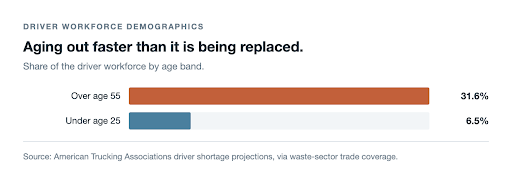
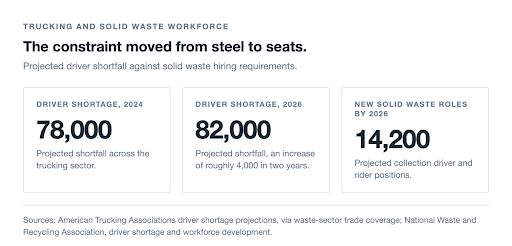
The American Trucking Associations projects a shortage of roughly 82,000 drivers across the trucking sector in 2026, up from about 78,000 in 2024. The demographic underneath that number is the harder problem. Approximately 31.6 percent of drivers are now over the age of 55, against 6.5 percent under 25. The National Waste and Recycling Association projects roughly 14,200 new collection driver and rider positions in solid waste by 2026, a hiring requirement landing on a labor pool that is aging out faster than it is being replaced.
An operator facing that market does not have a container shortage. It has a driver-hour shortage, and container inventory is the wrong lever.
The arithmetic of a turn
Fleet utilization in roll-off operations is conventionally calculated as containers deployed divided by containers owned, expressed as a percentage. An operator with 50 containers and 35 on job sites is running 70 percent utilization.
That figure is less useful than it looks, because it rewards exactly the wrong behavior. A container sitting full in a driveway for six days counts as deployed. It is generating no revenue during those six days, occupying an asset, and waiting on a driver hour that has not been scheduled.
The measure that carries more information is the turn: a complete cycle of delivery, loading, retrieval, disposal, and return to service. Operators and dispatch-software vendors commonly cite a benchmark of at least 1.5 turns per container per month as the threshold that justifies the capital. That figure circulates as an operator rule of thumb rather than a published industry standard, and it varies widely by market density.
Turns, not containers, are what a driver hour produces. An operator who raises average turns from 1.5 to 2.0 per container per month has effectively expanded fleet capacity by a third without buying a single container, and without adding a driver seat that the labor market cannot reliably fill.
Why the rental window is a dispatch decision
This is where hauler economics and customer pricing meet, and the seam is not where either side usually looks.
The seven to 10 day rental window that the industry treats as a customer-facing product feature is also, from the yard, a scheduling buffer. A long window gives dispatch latitude. Retrieval can be batched by geography, slotted into an efficient route, and moved a day when a truck goes down. The customer experiences it as flexibility. The operator experiences it as slack.
Slack has a cost, and it is measured in turns foregone. A recent analysis in this sector examined the same window from the customer side. It found that flat-rate pricing bundles a period carrying almost no marginal operating cost to the hauler, and proposed a loaded-day ratio as a way to express the gap between days billed and days actively worked.
Read from the yard rather than the invoice, the same finding inverts. The days a customer does not use are days a container cannot be redeployed. In a market where containers were the scarce input, that slack was cheap. In a market where driver hours are the scarce input and container inventory is comparatively easy to finance, the calculation reverses. Slack now consumes the resource that is actually constrained.
The volumes make it worth solving
The disposal side is large enough that small efficiency gains compound. The Environmental Protection Agency estimated 600 million tons of construction and demolition debris generated in the United States in 2018, the most recent national estimate available, and more than twice the volume of municipal solid waste that year. Roughly 144 million tons of it went to landfill.
Market analysts place the dumpster and roll-off container rental segment near $7.44 billion in 2026, though published growth forecasts diverge sharply. Fact.MR models the segment expanding at roughly 3.4 percent compound annual growth, while other published projections put the figure closer to 10.7 percent over a longer horizon. The spread reflects genuinely different assumptions about residential versus construction demand mix, and an operator planning capital purchases against the optimistic figure is taking a position, not reading a consensus.
What both forecasts share is a demand profile weighted toward jobs smaller than the ones the current fleet model was built to serve.
The short-window experiment
Some regional operators have begun selling the compressed cycle directly, converting dispatch discipline into a customer-facing product.
Clean Slate Dumpsters, which runs 15-yard, 20-yard, and 30-yard containers across Hammond, Ponchatoula, and the surrounding Tangipahoa Parish communities in southeast Louisiana, sells same-week container drop and haul-off in Tangipahoa Parish under the name Fill and Go, aimed at jobs where debris is already staged and the container functions as a transport step. The company publishes a $15 per additional day rate against base rates of $349 to $499, which makes the underlying economics unusually legible: the incremental day is priced near the marginal cost, and the product being sold is the retrieval commitment.
The operational demands are real. A short-window product converts a scheduling buffer into a scheduling promise. Retrieval slots have to be held rather than batched opportunistically, which raises truck legs per revenue dollar and works only where route density is high enough to absorb the loss of batching efficiency. It favors operators with tight service radii and direct control of the haul, and it disadvantages brokered networks that subcontract retrieval and cannot commit to a window they do not dispatch.
An operator without that density who sells a short window is selling a promise the route cannot keep, which is a worse customer outcome than a long window that was never binding.
The measurement gap
The obstacle to any of this is that most small operators cannot see their own turn data cleanly.
Container tracking hardware and dispatch platforms have made per-asset cycle times visible for operators who have deployed them, but adoption across small and mid-size haulers remains uneven, and many still reconstruct turn performance from billing records after the fact. Billing records are a poor proxy. They capture when an invoice closed, not when a container came back into service.
The operators who move first on this will not necessarily be the ones with the largest fleets. They will be the ones who can answer a question most of the sector currently cannot: how many days of the last month did each container spend earning, and how many did it spend full and parked, waiting on a truck.
That question is answerable with equipment that already exists. What has been missing is a commercial reason to ask it. A labor market that will not supply driver hours on demand supplies the reason.
Disclosure: Clean Slate Dumpsters, referenced in this article as one regional operator, is a client of the agency that placed this piece. No compensation was received by this publication’s editorial staff, and the company had no approval rights over the content.

The macro analyst desk brings highly sought after financial news based on market analysis, insider news and company filings.